Greek Breakdown & Meaning
[1:3] • [4–6] • [7–8] • [9–11] • [12–13]
Text and Translation
Greek Text
12. Πολλὰ ἔχων ὑμῖν γράφειν, οὐκ ἠβουλήθην διὰ χάρτου καὶ μέλανος· ἀλλὰ ἐλπίζω ἐλθεῖν πρὸς ὑμᾶς, καὶ στόμα πρὸς στόμα λαλῆσαι, ἵνα ἡ χαρὰ ἡμῶν ᾗ πεπληρωμένη.
13. ἀσπάζεταί σε τὰ τέκνα τῆς ἀδελφῆς σου τῆς ἐκλεκτῆς. ἀμήν.
English Translation
12. Though I have many things to write to you, I did not want to write with paper and ink, but I hope to come to you to speak face to face so that our joy may be full.
13. The children of your elect sister greet you. Amen.
Graphical Grammar

Weighty Words
Since the weighty words are driving the syntactical discussion in this passage. See below in Syntax Sense for the discussion.
Syntax Sense
Πολλὰ ἔχων ὑμῖν γράφειν – The participle is concessive: “though / although I have many things to write.” How do we know it’s concessive? What is “concessive” or “concession”? This is another one of those grammatical terms that is helpful when you know what it means–because just knowing the terminology helps you see it better when it arises–but seems inscrutable when you first see it. A concession is acknowledging a point from an opposing view. “Will you concede, sir, that grammar terminology is dense but useful?” In grammar, it works the same way as in argumentation: one is acknowledging a point from an opposing view, frequently using clauses starting with although, even though, while, or despite to show contrast or an unexpected outcome in an argument or a sentence. For example, “Although the runner was tired, he kept running.” Now you see it: a concessive clause is a subordinate clause that expresses something contrary to the main clause.
How can we tell that some clause is concessive? There are Greek particles that do this (e.g., καί, καίπερ, οὐδέ, μηδέ, and constructions with ὅμως (nevertheless) or καὶ ταῦτα), but there is no such particle here. There is no morphological marker that signals a participle, like ἔχων, as concessive. The concessive function emerges from within the context of the sentence.
Here, John introduces a circumstance that might be expected to lead to writing (many things I have to write), but instead highlights why John chooses a different course. Thus, the participle is conveying the concessive force. It’s not merely that John is “having many things to write,” but that despite having many things to write, he’s taking a different course of action. In grammar, a concessive word or clause introduces or expresses a fact that makes another fact surprising:
οὐκ ἠβουλήθην διὰ χάρτου καὶ μέλανος – ἠβουλήθην = aorist → simple past: “I did not wish / I did not want.” διὰ + genitive = instrumental: “by means of / with paper and ink.”
ἀλλὰ ἐλπίζω ἐλθεῖν πρὸς ὑμᾶς – ἐλθεῖν is a complementary infinitive after ἐλπίζω (“I hope to come”). This is a very common construction (cf. Phil 2:19; 1 Tim 3:14).
στόμα πρὸς στόμα λαλῆσαι – Hebrew/Greek idiom = “mouth to mouth” → “face to face in English. See my notes at III John 14; and see also Num 12:8 LXX.
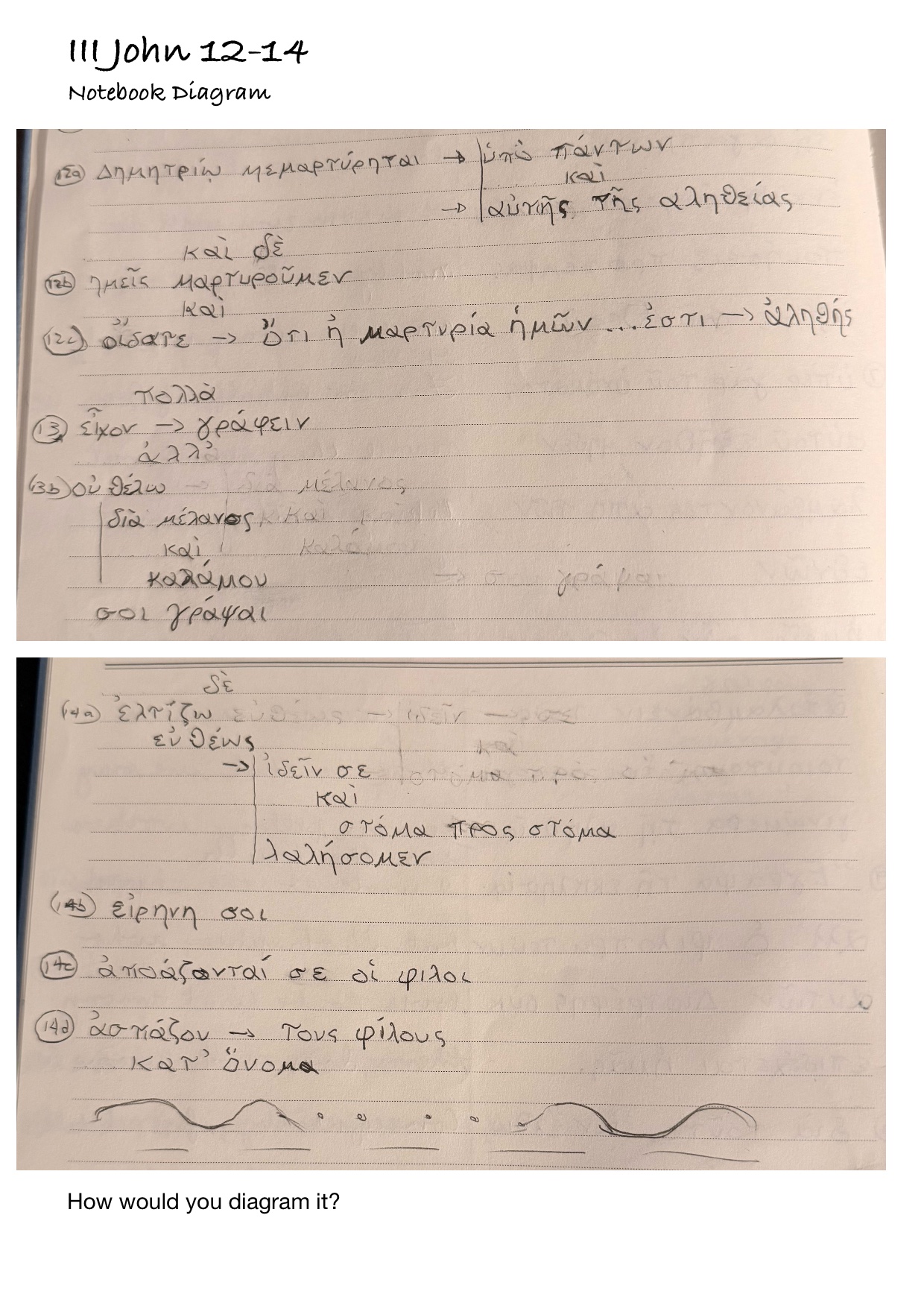
ἵνα ἡ χαρὰ ἡμῶν ᾗ πεπληρωμένη – ἡ χαρὰ ἡμῶν = “our joy” (definite article, shared joy of the whole community). ᾗ πεπληρωμένη = periphrastic perfect subjunctive (“may be / may stand made full/complete”). This is the same kind of phrasing as John 15:11; 16:24; 17:13; 1 John 1:4 — the Elder’s signature way of saying “so that the joy Jesus promised us will reach its intended, overflowing fullness when we’re together again.” Most literal: “so that our joy may be / may have been made complete.” “Will be full” is the modern English rendering and keeps the eschatological flavor.
ἀσπάζεταί σε = middle voice, present tense → “send you their greetings / greet you personally.”
Demystifying the Discourse
The letter opened with “The Elder to the elect lady and her children” (v. 1). It now closes with “The children of your elect sister greet you.” Whether one understands the ‘elect lady’ and her ‘elect sister’ as churches or households (see discussion here), the closing greeting underscores that faithfulness has not vanished—that there are still others standing in truth alongside them. It brings to my mind 1 Kings 19:18 — God has His faithful remnant. But that is not the message that John was conveying; it was his consistent message of the warmth of brotherly love. It’s a touching, heartfelt close that demonstrates to us today how we should love our brothers and sisters in Christ. The Elder’s closing greeting reflects the warmth and relational continuity that has characterized the entire letter.
Your turn!
You can engage with this passage at whatever level feels most natural. Choose one question, or simply reflect on the flow of the Greek.
- Grammar: The participle ἔχων is taken here as concessive (“though I have…”). Do you see any other grammatical possibility? What cues in the sentence push you toward—or away from—a concessive reading?
- Translation: στόμα πρὸς στόμα is rendered idiomatically as “face to face.” Would you prefer a more literal rendering (“mouth to mouth”), or do you find the idiomatic translation faithful to the sense? Where do you draw the line between literal wording and natural English?
- Discourse: What in II John—and in III John, if you wish to look there—foreshadows John’s preference for personal presence over further writing? Does this feel like a warm closing sentiment, or the natural outcome of the letter’s argument?
Previous passage: II John 9-11
Return to TBWM – II John
See complete translation of II John here.